
Verba :
AI platform for learning languages
Industry
EdTech
Scope
Mini App, AI companion
Year
2024
About the project
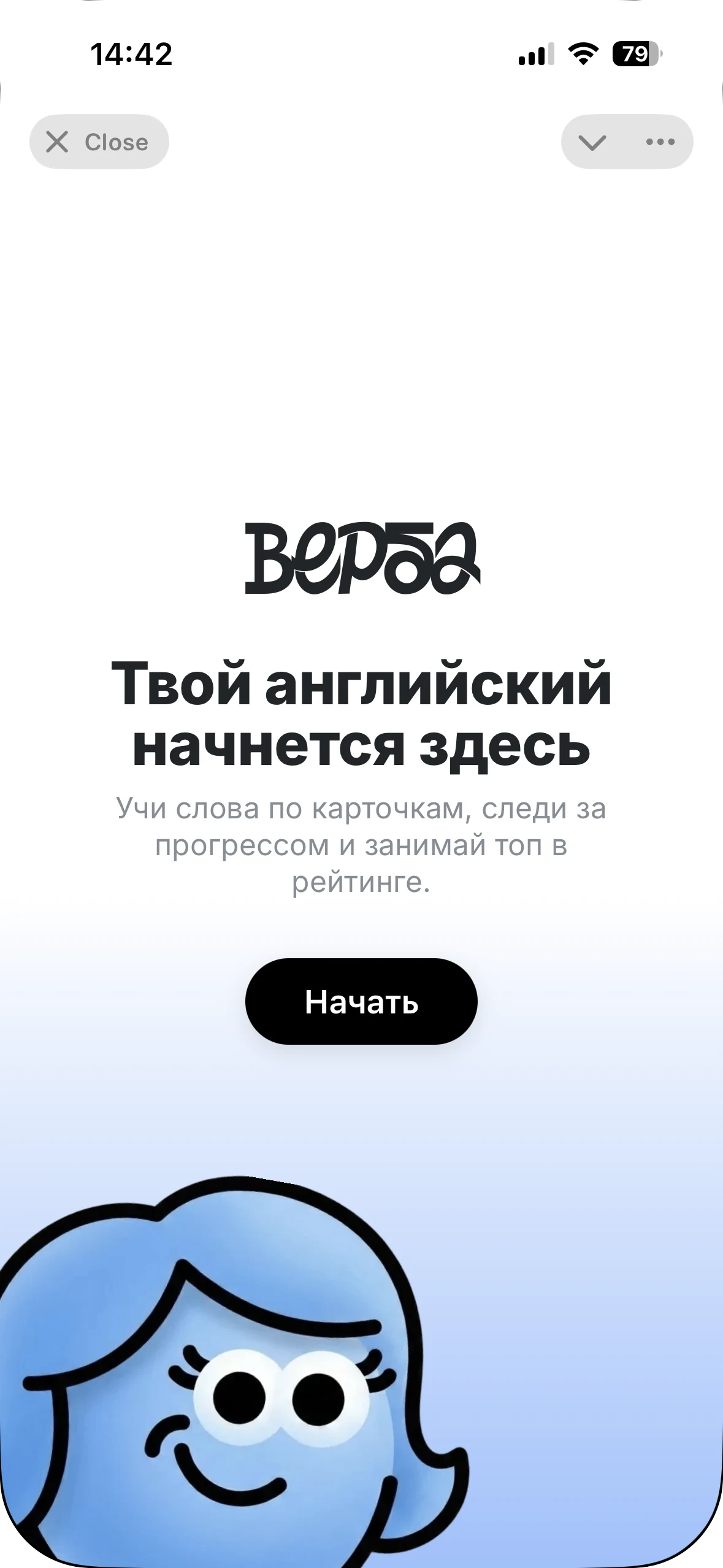
Verba teaches English inside Telegram: you open a chat and talk to an AI partner, and it corrects your mistakes and translates unfamiliar words right in the thread. No separate app, no textbook, no class schedule.
The task
- 01Build learning as a conversation, not a list of exercises: a language is picked up in speech, not in multiple-choice tests
- 02Fit a full lesson into a Telegram Mini App, with no separate install and no separate sign-up
- 03Keep the learner's level and progress between sessions, so the conversation resumes where it stopped
- 04Add subscriptions and split the free tier from the paid one honestly, without turning the free mode into a shop window
3
conversation modes with the AI
How we worked
01Conversation scenarios
We worked out what people actually want to talk about and reduced it to three modes: free chat, an everyday situation and a job interview.
02Design system and branding
Built the mark, the palette and the screen set so the app reads inside Telegram's own interface instead of fighting it.
03Mini App and the AI partner
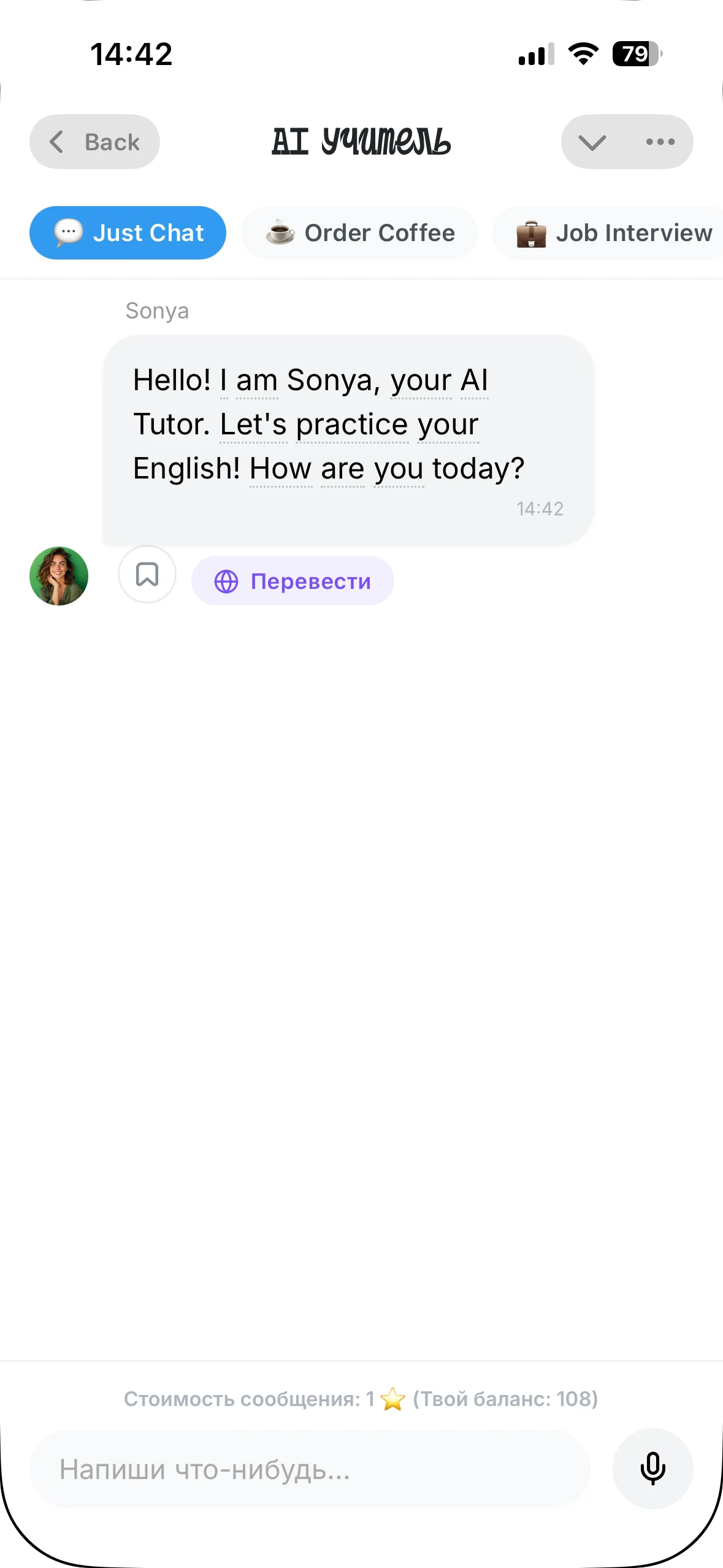
Chat with auto-translation and mistake breakdowns, a profile with level and progress, lesson screens.
04Subscription
Wired up payments and split access: a free mode to get acquainted, a paid one for daily practice.
Conversation scenarios
An open-ended chat with a model is intimidating: it is unclear what to talk about or when to stop. So the conversation is split into three modes, each with its own frame and its own point.
Free chat
A mode with no task and no script: the partner asks about your day, picks up the thread and does not let the conversation stall. It exists so people stop being afraid to write first.
Everyday situation
Ordering coffee, talking to a doctor, arguing with a phone carrier. The situation gives the partner a role and a clear ending, so a lesson does not drag on forever.
Job interview
The most common request from adults: they need the language at work. The partner holds the interviewer's role, asks follow-up questions and never switches back to the learner's own language.
Interface inside Telegram
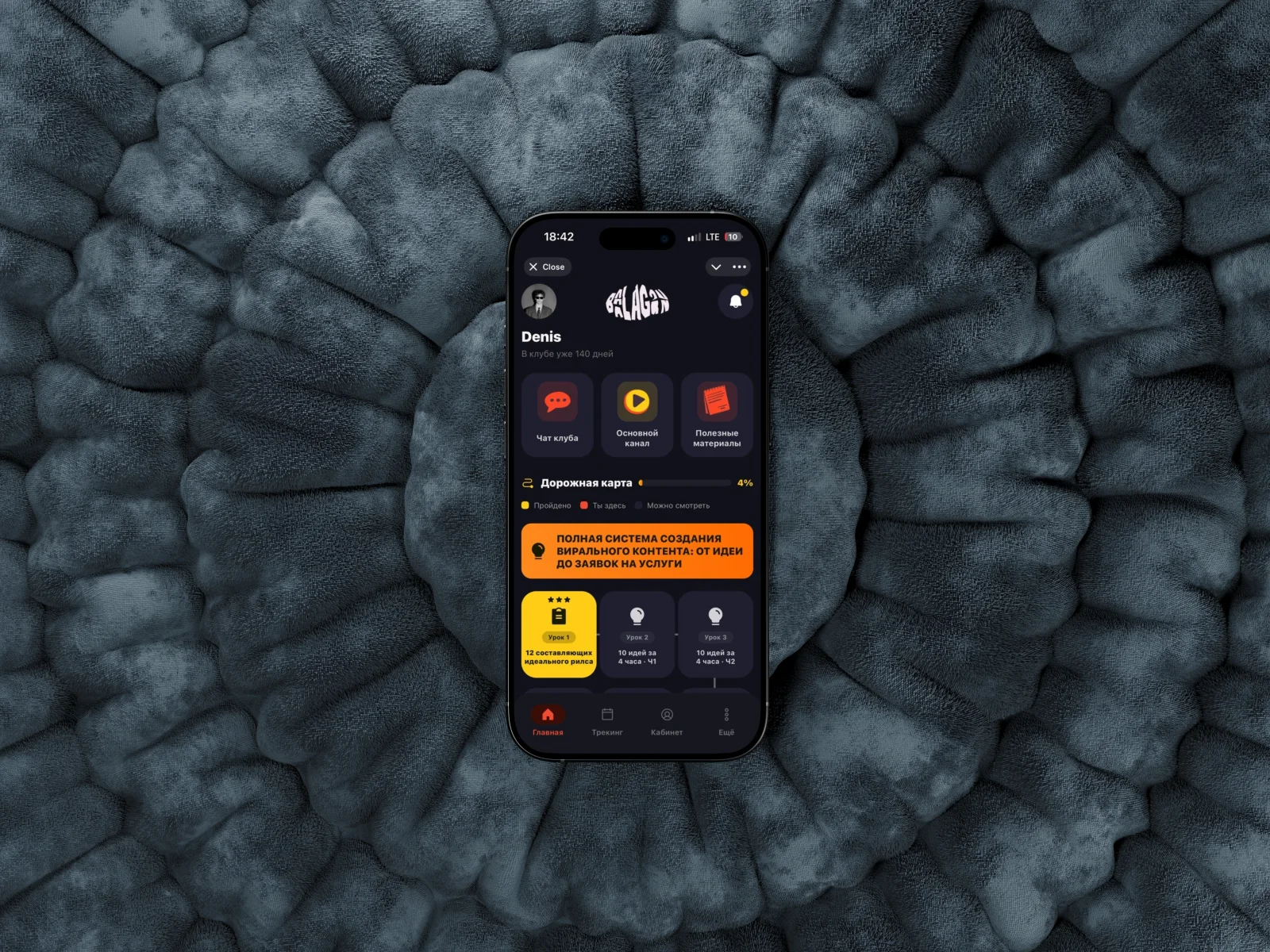
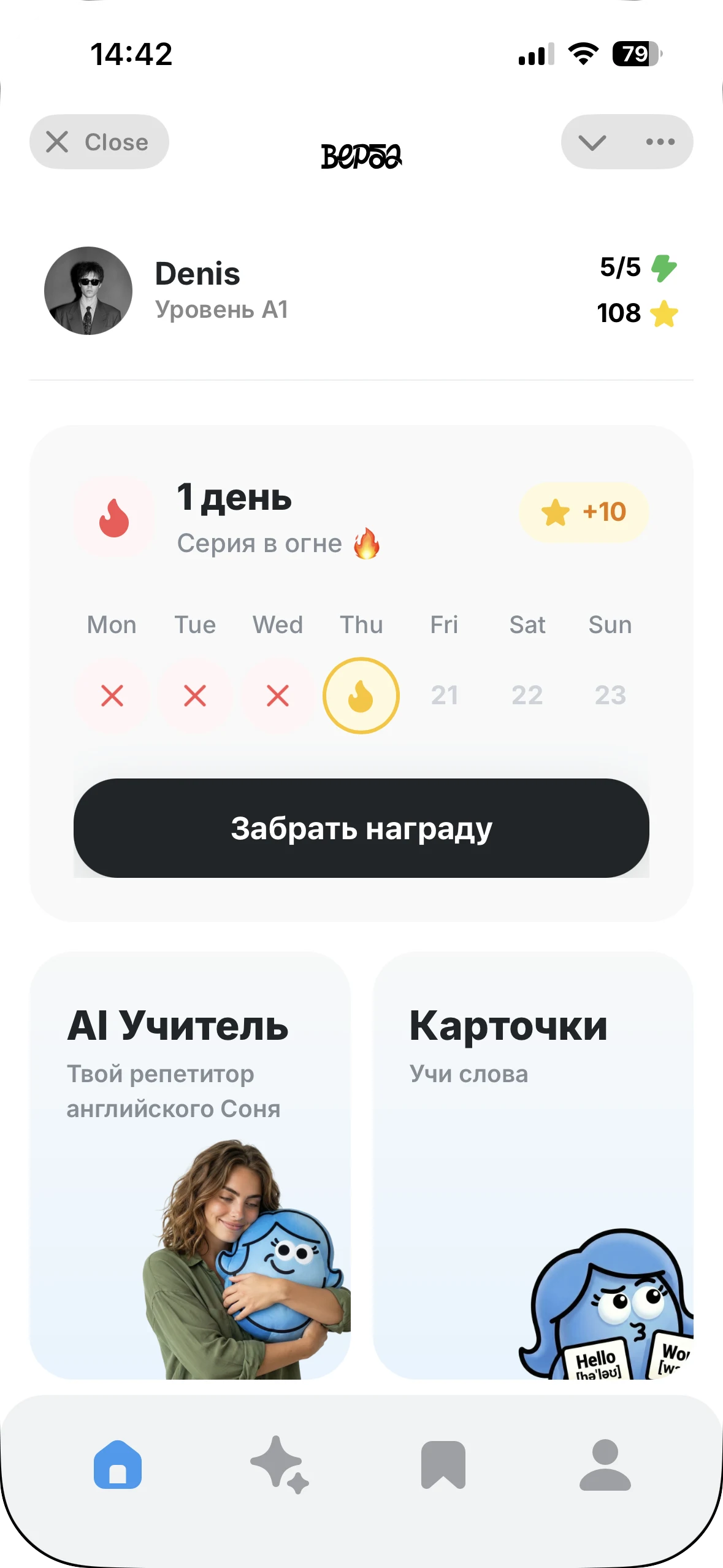
A Mini App lives in someone else's window: Telegram's header above, Telegram's bar below, the theme switching along with the client. An interface drawn without accounting for that reads as if it were forced in.
Mark and palette
The mark and the colours are built so the app is recognisable without fighting its surroundings: one accent, everything else neutral, and nothing washes out in Telegram's dark theme.
Lesson screens
The conversation takes the whole screen and everything auxiliary moves to the profile. The keyboard covers the bottom third, so whatever is needed mid-dialogue lives in the top half.
Profile and progress
Level, streak and the mistakes already worked through sit on one screen: it is the only place where a person sees that they have moved at all.
Working with mistakes
Speaking practice without feedback cements mistakes instead of removing them. But correcting every word is just as bad: people stop writing.
Breakdown after the reply
Mistakes are not stamped over the message but shown as a separate breakdown beside it: first you finish the thought, then you see what to fix.
Translation on demand
An unfamiliar word is translated inside the thread, with no trip to a dictionary. The translation is not substituted automatically: it appears on tap, otherwise reading is easier than understanding.
Level memory
The level is not asked for in a form at the entrance but inferred from the conversation itself and kept between sessions, so the partner does not reset to zero every time.
How it works underneath
A Mini App is an ordinary web app that Telegram opens in its own window. That sets the requirements: load on a weak connection, recognise a person without a password, and not lose the thread when the window is closed.
Entry without sign-up
Telegram itself identifies the person and hands verified data to the app. No email, no password, no code by SMS: the path from tap to first reply takes seconds rather than a minute.
Storing progress
The thread, the level and the mistakes worked through live in their own database, not in the window's memory. You can close the Mini App, come back a week later and pick up where you were, on another device too.
The conversation layer
Language models sit behind the partner's replies, while the script, the role and the limits of each mode are set on our side. The model answers, but it does not decide how a lesson should end.
Subscription
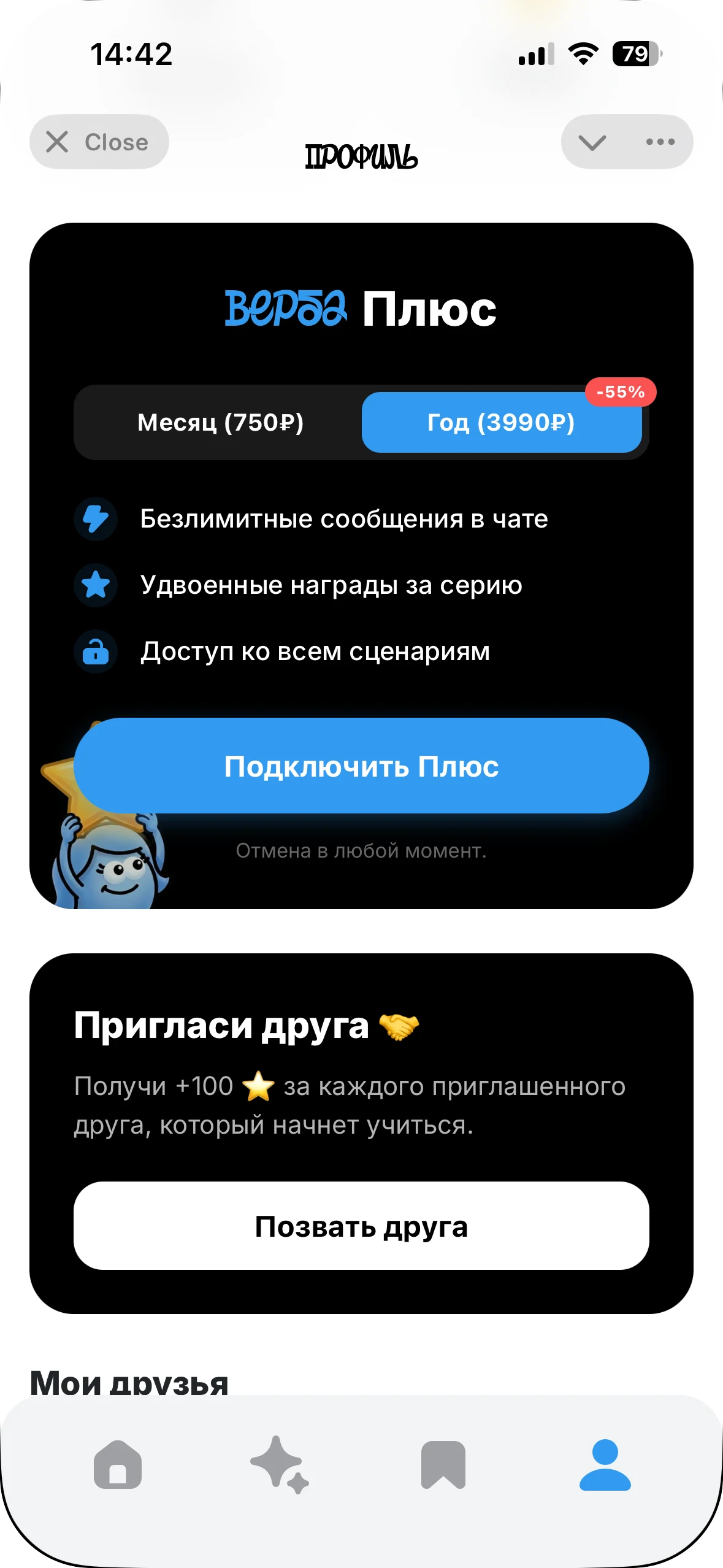
In learning, people pay for regularity rather than for access: trying it once should be free, practising every day should be paid.
Free mode
A full conversation, not a teaser: a person has time to work out whether this helps them before being asked to pay.
Paid access
Lifts the limits and opens every scenario. Payment goes through inside Telegram, so nobody leaves for a third-party site in the middle of a lesson.
Built with
React
Telegram Mini Apps
Node.js
Language models
PostgreSQL
Outcome
The product lives where people already spend their day: to practise you do not open a textbook, install an app or remember a password, you open a chat. Branding, the design system and every screen are fully closed, the conversation runs on language models, and payments and access tiers are wired up. From here the product grows on the same foundation: a new scenario is added as one more conversation mode, not as a separate section of the app.
A conversation with a machine only works when it has a frame: a role, a topic and a clear ending. Without one it is not a lesson, it is small talk.