
Askora :
Telegram bots built from a sentence
Industry
SaaS
Scope
SaaS, AI bot builder
Year
2026
About the project
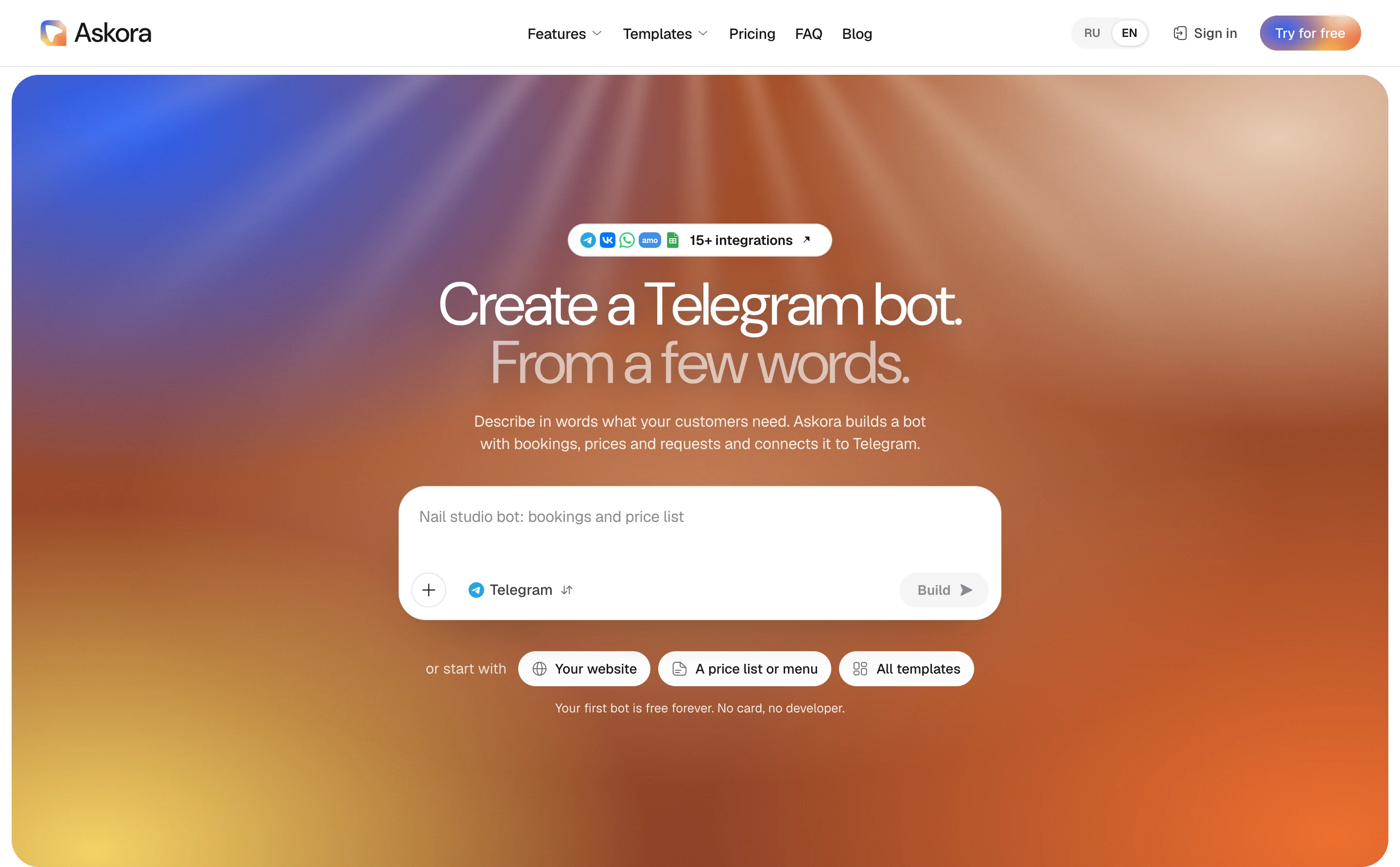
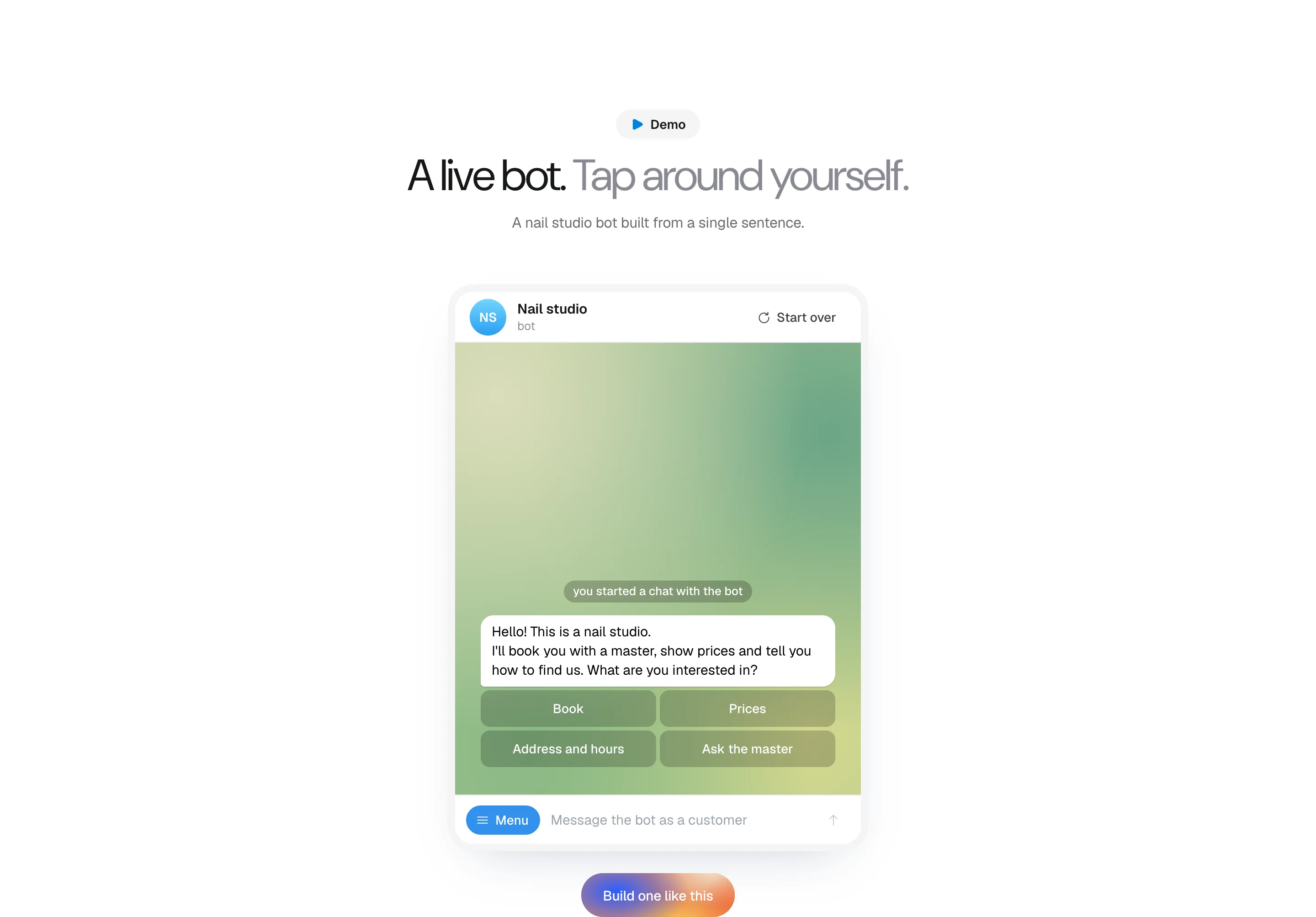
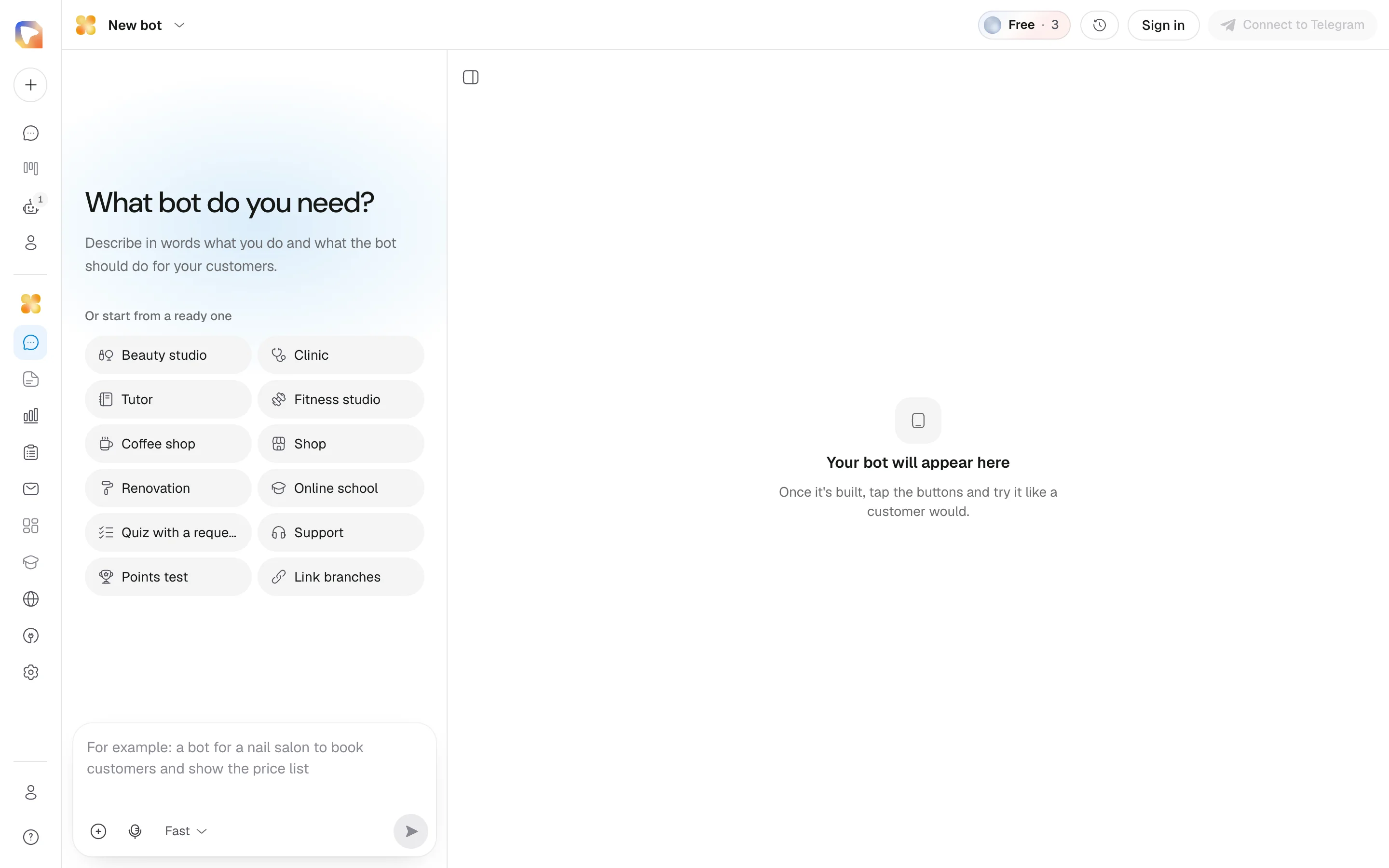
Askora builds a Telegram bot from a plain description. You write what your business does and get a working bot with a greeting, a menu and steps, then edit it the same way: by typing a sentence in the chat. It is our own product, and we build it ourselves.
The task
- 01Take the block diagram out of bot building: agencies draw those, salon owners do not
- 02Make edits work in plain words, so that «add bookings on Saturdays» simply happens
- 03Cover everything a bot is bought for inside one product: bookings, leads, a shop, payments
- 04Connect a bot without BotFather and without a token, in one tap
11
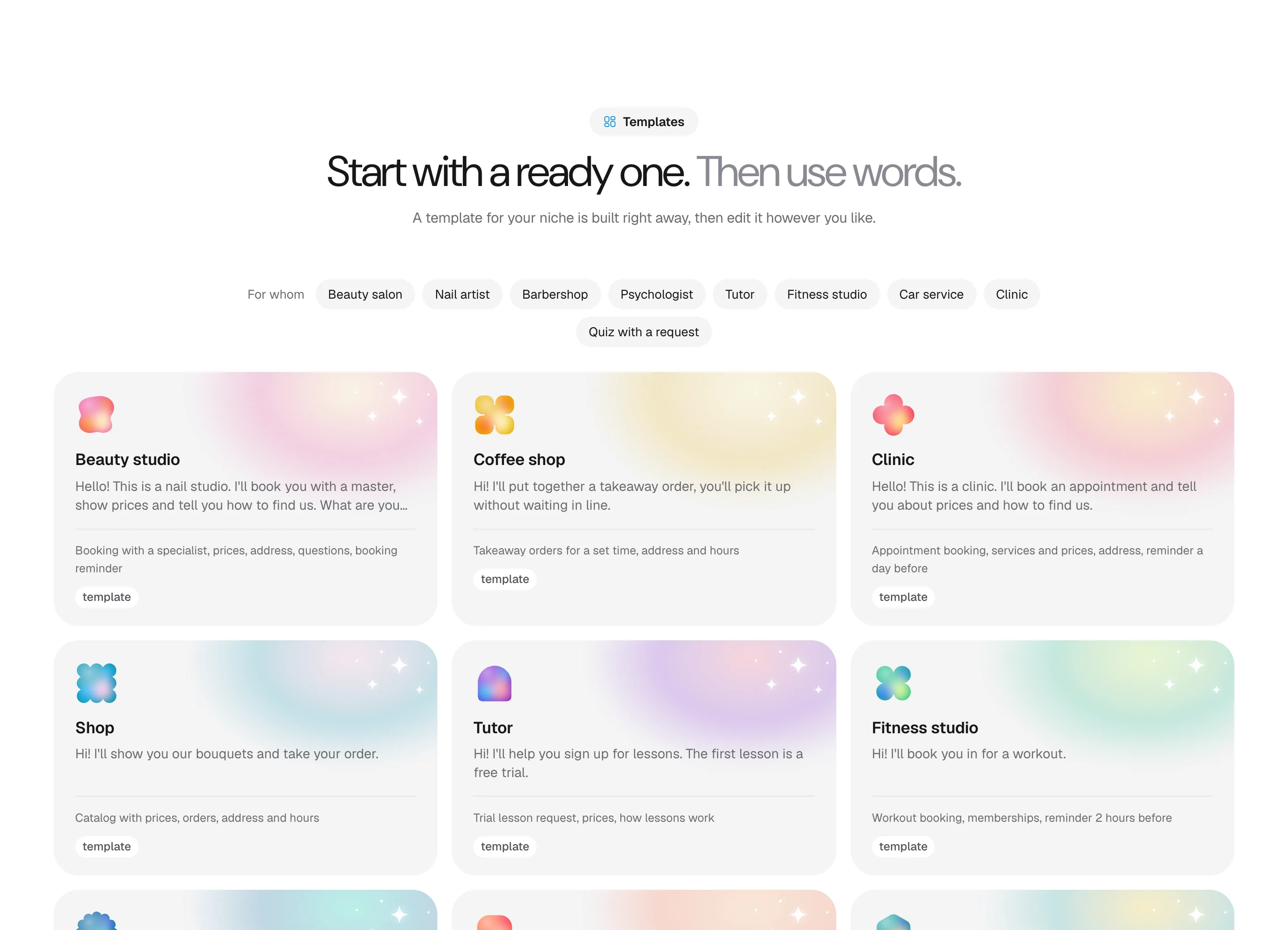
ready-made niche templates
2
interface languages
0
lines of code from the bot owner
How we worked
01A bot schema instead of a builder
Defined one shared set of steps that any bot is assembled from. There are deliberately no niche-specific types: bookings, shops and courses are chains of the same steps.
02One interpreter
The same code runs the config in the studio and on the bot server. The preview and the live bot cannot drift apart, because they are one program.
03Editing in words
Taught the agent to change an existing config from a phrase instead of rebuilding the bot, so nothing already set up gets lost.
04Modules on top of the schema
Time slots, a shop with a cart, payments, broadcasts and AI answers switch on and off as whole modules, leaving no traces in the shared core.
05Credits and plans
Builds and AI answers draw on one balance. The cost is shown before a build starts, and a build that fails is not charged for.
Why not a builder
The market is built around the block diagram. We think that is exactly the barrier.
Who actually builds it
On Salebot and platforms like it, a bot is drawn as arrows between blocks. An integrator can do that; the owner of a nail studio cannot, and she is the one paying for the bot.
What replaced it
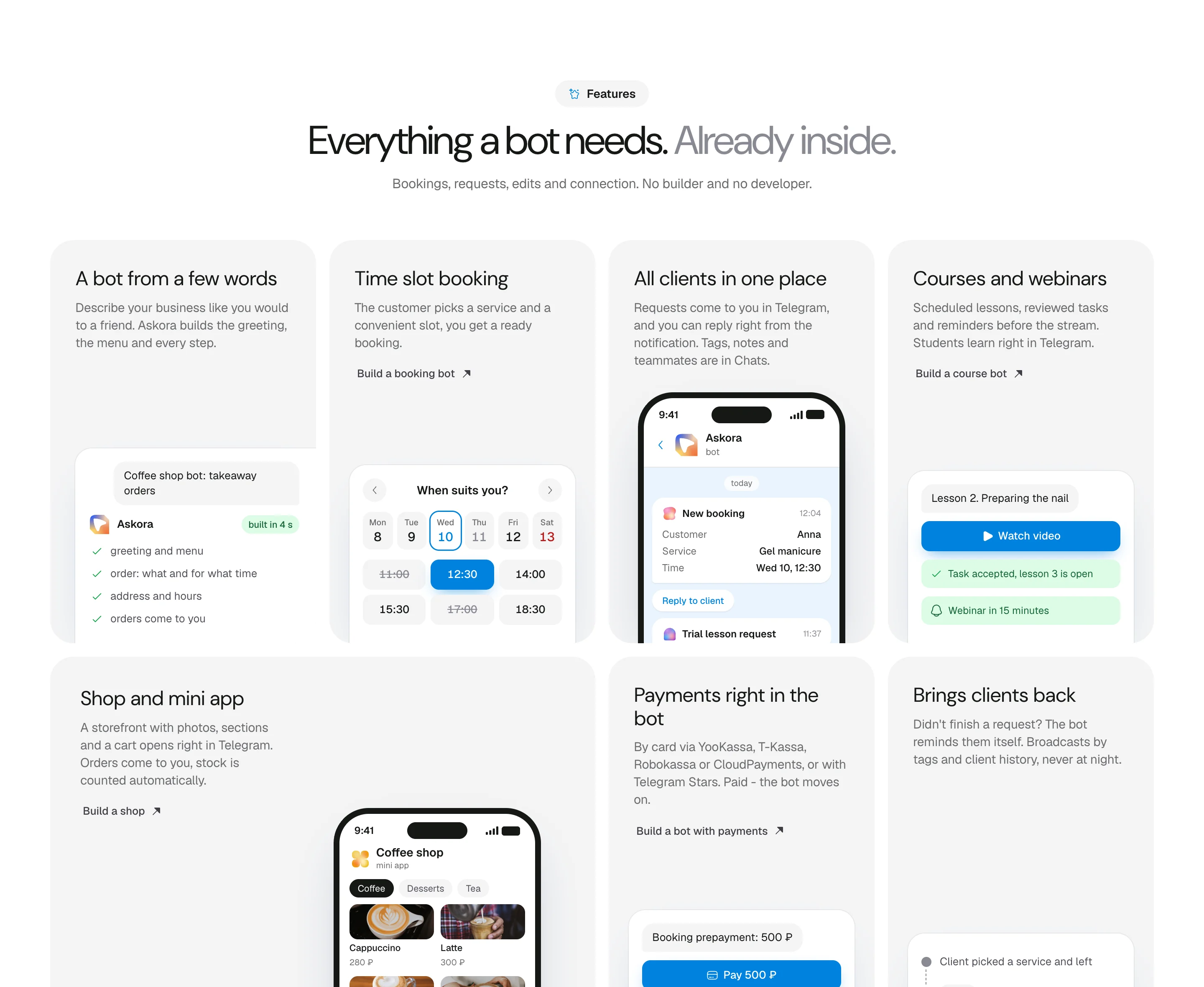
A description in plain words. Askora parses it and assembles the greeting, the menu and the steps itself, in a few seconds.
The diagram stayed
The bot map is still there, but it is the result rather than the input: people open it to look and adjust, not to build from nothing.
What the bot can do
Everything a bot gets bought for sits inside the product and turns on with a switch.
Bookings and leads
The customer picks a service and a free slot, the owner gets a ready booking in Telegram and replies straight from the notification.
Shop
A storefront with photos, sections and a cart opens as a mini app inside Telegram, and stock is counted automatically.
Payments
By card through the owner's own till or with Telegram Stars. We add no fee on top; the money goes to their account.
AI answers
The bot answers free-form questions from the owner's price list and rules, and hands over what it does not know.
Connections
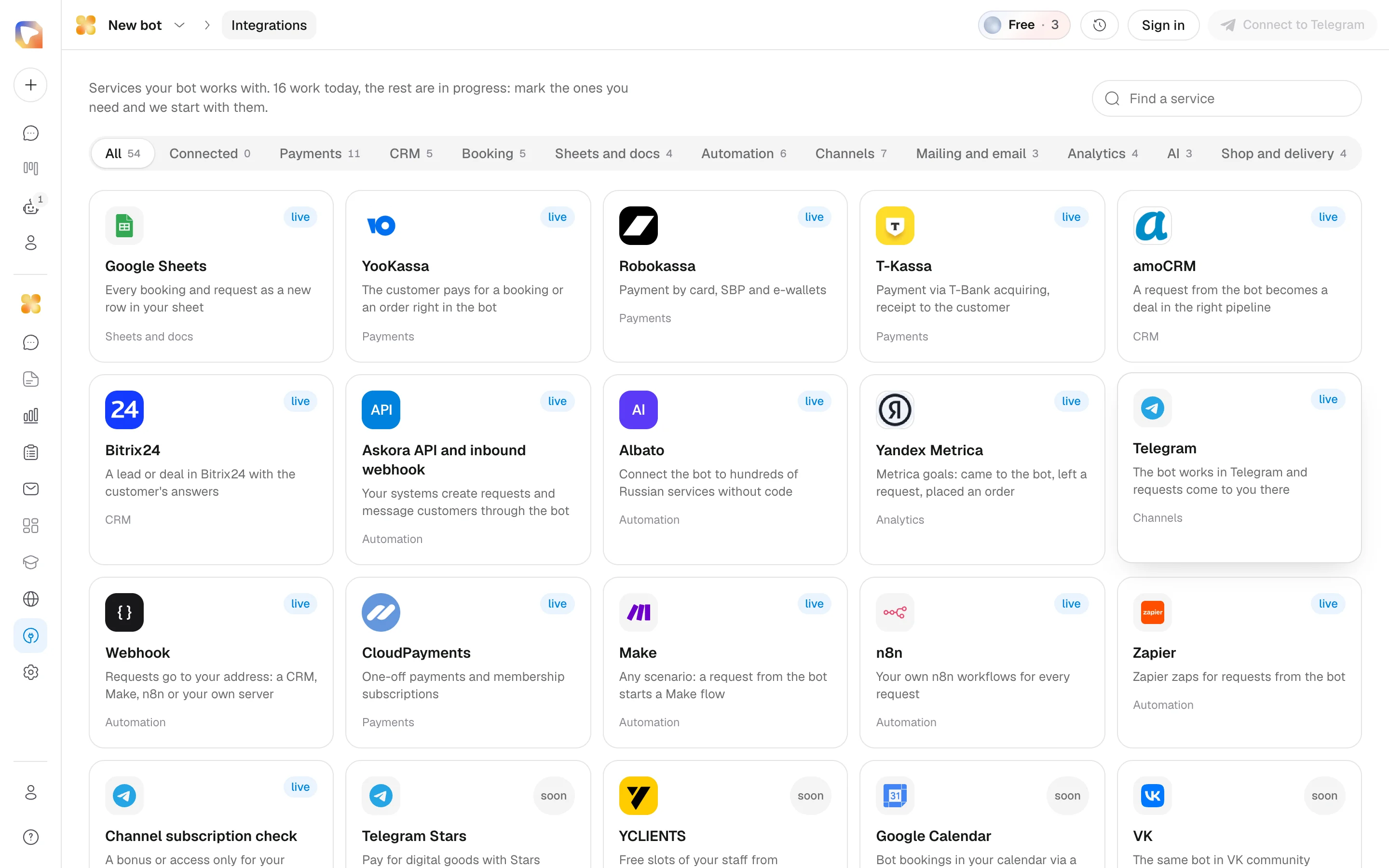
Sixteen working services: payment tills, amoCRM, Bitrix24, Google Sheets, Make, n8n, Zapier, Metrica and an inbound webhook.
What holds it together
The product is ours, so the decisions were made for years of use rather than for a demo.
One execution path
The config interpreter is shared by the studio and the bot server. There is simply nothing for the preview and the live bot to drift apart on.
A module switches off whole
Niche logic does not leak into the shared parts: bookings live in their own module, and turning it off touches neither the schema nor the server.
A template as the way in
Eleven ready niches, from a beauty studio to a car service: nobody has to start from an empty field, and from there it is edited in words.
Built with
React
TypeScript
Outcome
Askora is live: a bot is assembled from a couple of sentences, connects to Telegram in one tap and handles bookings, leads, a shop and payments. The first bot is free, paid plans follow. The product keeps growing; the next big piece is modules for complex scenarios.
Nobody buys a bot for the sake of a block diagram. They buy it for bookings and leads. So we removed the diagram.